













ARTICLE
Building the next generation of behavioral health platforms
Jul 22, 2026
Read time: 9 min
The behavioral health sector represents one of healthcare’s most distinct platform-building opportunities.
The Substance Abuse and Mental Health Services Administration (SAMHSA) reports that 61.5 million US adults experienced a mental illness in 2024, yet only about half received treatment. This pervasive gap between need and access is driving innovation and investment across the sector, including how behavioral health providers are approaching growth and choosing pathways to scalability.
To reap the benefits, behavioral health operators are seeking out specialization, including a more comprehensive approach to pre- and post-diagnosis support and education. The organizations that are building focused clinical platforms, pursuing more integrated models of care, and investing in capabilities to support more complex operations are the ones staying ahead of the curve.
Discussions at McDermott HealthEx 2026 explored how these shifts are influencing investment activity and strategic dealmaking across the behavioral health landscape, including:
Bullish market outlook amidst regulatory shifts
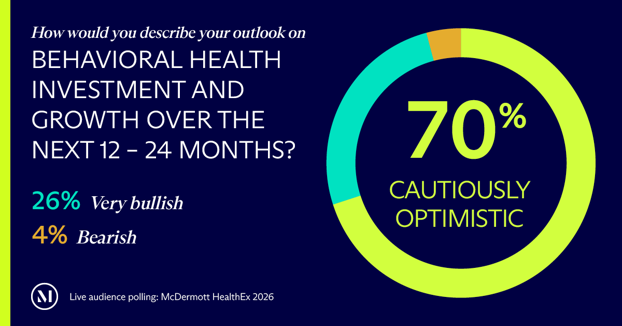
Poll responses reflected strong optimism about the sector. Panelists expressed similar confidence in behavioral health’s trajectory, with one noting that we’ll likely see a “cascade or almost an avalanche of growth” in the coming years. This tremendous opportunity is driven by pent-up demand and persistent gaps in care access, particularly in rural and underserved communities where behavioral health providers and inpatient capacity are limited.
At the same time, discussions focused on how Medicaid coverage reductions and broader agency changes stand to strain providers that depend heavily on government reimbursement.
The One Big Beautiful Bill Act (OBBBA), for example, introduces new operational considerations for behavioral health providers with significant Medicaid exposure. Although individuals with substance use disorders and certain mental health conditions are exempt from the law’s community engagement requirements, recent Centers for Medicare and Medicaid Services (CMS) guidance places responsibility on states to define qualifying conditions and establish verification processes, creating uncertainty around implementation and patient access.
To help combat these losses, state innovation efforts, carve-outs, parity enforcement, and value-based care models can create new avenues for growth and better access.
Capital is flowing, but the market is becoming more specialized
Panelists emphasized that behavioral health is no longer a single investment category, but a collection of distinct subsectors, including:
- Autism support services
- Outpatient mental health treatment
- Substance use and addiction treatment
- Intellectual and developmental disability (IDD) services
- Other specialty categories (e.g., eating disorders)
Each subsector comes with its own workforce, reimbursement, and operating requirements. Investors are evaluating these differences more closely and in consideration with longer-term goals and financing strategies.[5.1][5.2] As transaction timelines lengthen and underwriting becomes more rigorous, buyers are placing greater emphasis on clinical quality, workforce stability, and the operational capabilities required to support long-term growth.
The autism market reflects that shift, with one panelist describing a growing “flight to quality” focused on high-performing providers. Investors are placing a premium on providers that have the infrastructure to grow, “not just to add more sites and more clients,” but to sustain quality as they scale. Another added that organizations with strong operating foundations are likely to emerge stronger as the market continues to consolidate.
Specialization is creating new opportunities
Specialization matters in behavioral health care delivery. Providers are building organizations and offerings around specific patient populations and treatment approaches rather than broad service portfolios. This focused approach helps with patient recruitment, referral development, and achieving positive clinical outcomes, but only when supported by the right infrastructure and support services.
Autism services is one are a where more specialized expertise can support both growth and better outcomes. Providers building treatment around an individual’s specific needs and circumstances – rather than around standardized measures like number of therapy hours per week – are better positioned to demonstrate clinical impact and meaningfully engage payors in value-oriented conversations. Having well-established clinical protocols and more comprehensive quality measurement frameworks can help organizations scale while maintaining the characteristics that made them successful in the first place.
Interventional psychiatry (e.g., TMS, esketamine, and infusion-based therapies) is also on the rise. While increasingly being used in outpatient behavioral health platforms, it is still seeing uneven in-patient adoption, given both limited reimbursement pathways and patient awareness.
Organizations that invest now in building physician expertise, intake infrastructure, and referral relationships for these newer modalities are likely to be better positioned as the market matures – particularly if reimbursement coverage expands and new indications receive regulatory clearance.
Reimbursement reform is reshaping behavioral health’s future
McDermott HealthEx poll respondents unanimously identified reimbursement reform – including changes to payment models, CPT codes, and provider eligibility – as the factor most likely to reshape behavioral health in the near term:
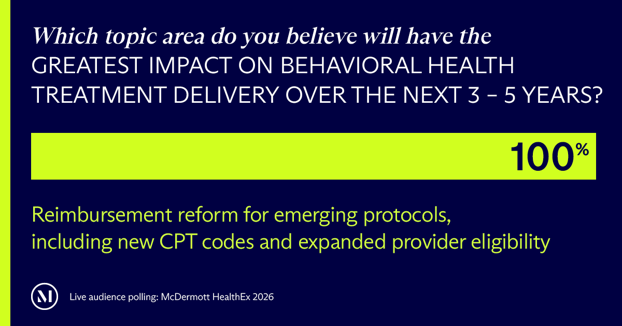
Panelists noted that expanding reimbursement for integrated care models, telebehavioral health, and emerging treatment protocols will help unlock new growth opportunities by allowing providers to deliver care more efficiently, broaden the types of clinicians who can practice at the top of their licenses, and make innovative services economically sustainable at scale.
State investments in crisis infrastructure, community-based care, and behavioral health redesign are also creating additional avenues for reimbursement and expansion, if they’re able to produce measurable results. As one panel discussed, standing up community-based crisis programs – particularly those focused on mobile response and stabilization services (MRSS) – can demonstrate meaningful reductions in emergency department utilization and downstream system involvement when replicated across a state.
Where these outcomes can be documented and sustained, and presented as a “demonstrated business case” to both CMS and SAMHSA, as one panelist detailed, they can open new reimbursement pathways and create further expansion opportunities for providers.
Growth requires stronger foundations and better patient access
The greatest constraint on behavioral health growth is capacity. Demand regularly exceeds available service providers, creating opportunities for providers that can expand access and provide more complete support and education, especially in growing needs bases.
In autism care services, families in some markets may wait 12 months or longer for a diagnosis and subsequent treatment, not including the time-intensive evaluations that precede that diagnosis. Families and patients also need meaningful support to understand that diagnosis, its potential impact, and available treatment options.
Whether with autism or another complex behavioral health condition, providers that address both the diagnostic and the post-diagnosis education and support gap are solving a more complete version of the access problem, which requires more than a steady opening of new sites of care to solve. This more comprehensive approach requires well-established clinician pipelines, better clinical oversight, and more extensive care delivery models that can be replicated across markets. Providers that build those capabilities can turn access challenges into sustainable growth opportunities.
Managed care organizations are also playing a larger role in defining network requirements, quality expectations, and reimbursement structures. Providers that can improve care access by working collaboratively in their markets – while operating effectively in performance-oriented models – will stand a better chance of growing long-term and differentiating themselves in a crowded market.
Technology is enabling specialization and better integration
Unlike more mature healthcare segments, many behavioral health organizations still have substantial opportunities to strengthen core infrastructure, standardize workflows, and invest in scalable platforms in support of long-term growth and increased attractiveness to potential buyers.
One panel described behavioral health’s relatively immature technology infrastructure, electronic medical records (EMR) capabilities, and operating systems as a source of significant upside rather than a disadvantage, given the ability to create and customize solutions as needed. At the same time, panelists emphasized that strong technology foundations – from EMR integration and revenue cycle capabilities to data and outcomes measurement – are becoming increasingly important differentiators as investors place greater emphasis on operational rigor and demonstrated growth capabilities.
In autism services, panelists highlighted how AI is supporting earlier diagnoses, creating greater consistency in clinical decision-making, and helping clinicians serve more patients without sacrificing quality. Technology is most valuable when it strengthens, not replaces, the operational and clinical foundations that differentiate high-performing organizations.
Integrated care is reshaping behavioral health delivery
Integration is a strategic priority as organizations seek to improve care quality, enable more seamless patient engagement, and create more coordinated experiences for patients with complex behavioral health and comorbid conditions. Behavioral health providers with care models that extend beyond individual encounters are gaining more market attention.
Substance use disorder (SUD) treatment presents immense opportunities for organizations looking to connect treatment needs, recovery support, and ongoing rehabilitation. Interest is growing in longitudinal care models that maintain engagement over time and provide greater visibility into patient progress. These approaches align with broader efforts to improve outcomes while reducing fragmentation.
As one panelist described, their organization’s SUD care model has a three-part clinical framework: outpatient counseling at the core, wrapped with medical care from physicians and nurse practitioners, anchored by a third component of recovery support services addressing social determinants of health. The combination of all three – under one roof, and simultaneously for each patient – is what drives differentiated outcomes.
The shift is influencing payor strategy as well. There is a growing demand for measurable outcomes and performance-based reimbursement. Organizations pursuing these arrangements will need to be able to track outcomes consistently and demonstrate clinical impact.
Looking ahead
Growth in behavioral health won’t come without friction. Workforce shortages are creating obstacles for nearly every segment. Regulatory complexity and reimbursement variability remain unresolved. The gap between what patients need and what the system delivers hasn’t closed.
Some behavioral health organizations see partnerships as the path to scale and new operational capabilities, while others are evaluating new market opportunities and expanding service offerings in search of a competitive advantage.
The behavioral health landscape has transformed, and organizations need to find a new way forward. The platforms best positioned to scale and lead are the ones improving care access, meaningfully impacting outcomes, and turning a typically fragmented collection of services into a longitudinal, integrated care experience.