













ARTICLE
From hype to execution: Scaling health tech platforms
April 8, 2026
Read time: 6 min
The next wave of healthcare dealmaking will be won by tech-enabled platforms driving value and efficiency at scale.
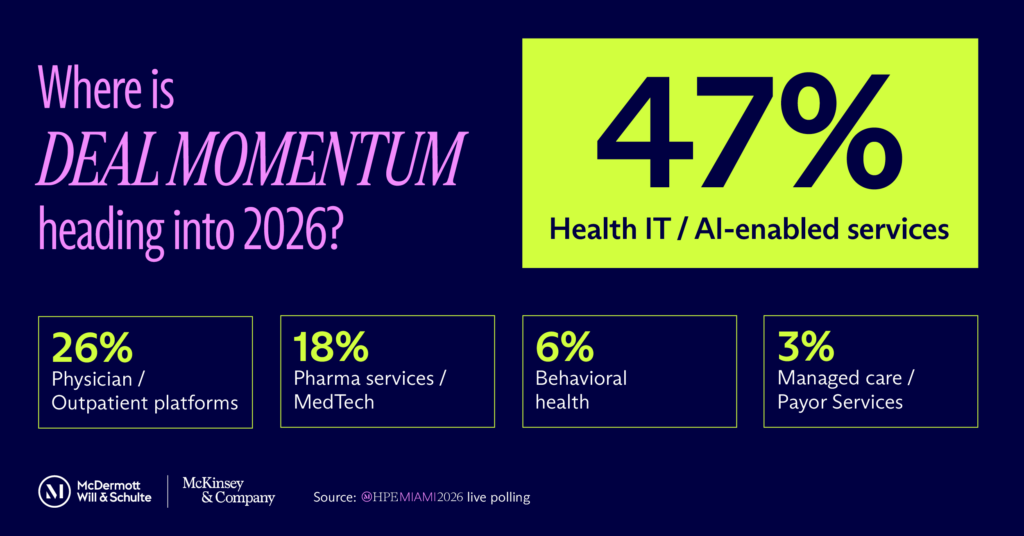
At McDermott Will and Schulte’s HPE Miami 2026 conference, discussions among investors, operators, regulatory experts, and strategic buyers reinforced that healthcare technology is no longer a speculative growth category. It has become a core value driver and investment differentiator.

The proliferation of tech-enabled platforms – like those touching revenue cycle management, AI-enablement, and payor-provider services integration – has set a new standard for what constitutes a premium asset in healthcare. Investors are eschewing standalone growth stories to focus on proven, scalable businesses, like those that can seamlessly integrate AI and digital infrastructure into everyday healthcare operations and make a measurable difference in care delivery (e.g., clinical productivity, care quality, margin expansion, etc).
In an increasingly complex regulatory environment, where investors and operators are rethinking what operational rigor must look like, diligence, discipline, and execution have replaced exuberance about potential in healthcare technology investing.
Timely trends that stood out among healthcare dealmakers’ reflections at HPE Miami 2026 include:
AI strategy is now a diligence requirement
Key takeaway: AI enablement has firmly shifted from excitement to execution, with investors looking past “AI potential” in favor of use cases showing demonstrated success and regulatory readiness.
Investors need a clear understanding of how companies are using AI, not just that they are.
Platforms that embed AI directly into provider and payor workflows – whether through clinical decision support, revenue cycle optimization, or administrative automation – are continuing to gain traction, while raising a new set of validation questions among buyers, including:
- Does the AI solution meaningfully improve outcomes or efficiency?
- Is adoption measurable and sustained within end-user workflows?
- Can performance claims be validated with real-world data?
Failure to validate these areas could negatively affect deal outcomes, impacting everything from pricing and structure to willingness to transact.
Investors must prepare for heightened scrutiny around issues such as data governance, model validation, algorithm transparency, clinical decision support frameworks, patient privacy implications, and other risk management considerations.
Legal teams should work closely with operator deal teams to evaluate all AI-related representations, data rights, and compliance frameworks early on, while investors should treat regulatory readiness as a core underwriting input and necessary scalability driver instead of a post-close consideration.
Tech-enabled behavioral health and PPM platforms are scaling
Key takeaway: The most important investor consideration is whether a platform can scale operationally and digitally across multi-site networks, with less focus on geographies.
While behavioral health and PPM platforms continue to attract significant investor interest, the investment strategy behind these deals is shifting, because they’re operating more like technology-enabled platforms than standalone businesses.
Because multi-site platforms in behavioral health and PPM face more complex regulatory requirements related to billing compliance, licensure, supervision models, and corporate practice of medicine doctrines, investor diligence must touch each of these areas.
Diligence must also include identifying distinct platform growth drivers and compliance gaps, particularly those related to billing and clinical operations, as these can materially affect valuation and post-close integration planning.
RCM and health IT still anchor deal activity, but require nuance
Key takeaway: While revenue cycle management (RCM) and health IT services continue to drive investment interest, buyers can no longer rely on broad enthusiasm as a proxy for asset quality and growth potential. Investors today must focus on sustainable margins and integration ability rather than category-level enthusiasm.
Tech-enabled services that are embedded directly into behavioral health and PPM workflows tend to make them “stickier” for users, because they support recurring revenue models and higher switching costs. This deeper end-user integration often translates to long-term value creation.
Buyers are increasingly underwriting these features directly into valuation assumptions, particularly where platforms can show standardized workflows, scalable infrastructure, and evidence of repeatable performance across locations.
Investor diligence here should assess areas like integration depth and platform defensibility, including whether a solution creates meaningful switching costs and can sustain margins in an increasingly competitive technology market.
Exit appetite favors integrated, proven assets
Key takeaway: Investors seeking exits must look for data-rich assets with a track record of performance and proven defensibility over early-stage promises or narrative-driven growth stories.
Exit opportunities in today’s environment are strong, but selective. Strategic investors are looking for platforms that can seamlessly integrate into existing operations versus those requiring significant transformation post-acquisition. This shift places a premium on:
- Standardized processes across multi-site platforms
- Interoperable technology systems
- Strong compliance and governance frameworks
- Demonstrated performance (e.g., improvements in outcomes, efficiency, or revenue)
Data is also a central component of exit valuations. Platforms with demonstrated successes in distinct use cases are more likely to command premium valuations, especially when they show measurable outcomes and improvements across key performance indicators.
From a transaction perspective, this environment reinforces that early exit planning, with data to support impact, is critical. Investors must understand platform growth and defensibility mechanics with the end user in mind, aligning operational, technological, and compliance capabilities with buyer expectations.
Looking ahead: Making disciplined health IT investment decisions
Across all sectors discussed at the forum, a common theme emerged: discipline is replacing exuberance in healthcare technology investing. Success increasingly depends on diligence processes, ROI from deeply embedded tech (especially AI), and the ability to execute in volatile regulatory and fragmented clinical environments.
For healthcare investors, growth equity firms, and corporate development leaders, the implications are clear. Successful transactions will require deeper, more integrated diligence processes; stronger alignment between legal, regulatory, and operational teams; and strong technology and operational understanding of how to grow and optimize healthcare platform investments.