






ARTICLE
Plenty of capital, fewer easy wins in healthcare PE
Oct 29, 2026
Read time: 6 min
Healthcare private equity investors are seeing a new phase of opportunity, with substantial capital available for deployment, improving deal prospects, and accelerating AI adoption reshaping the investment thesis. But growth prospects vary considerably across healthcare sectors, and generating returns will require greater discipline around deal selection, operational execution, and technology investment.
At McDermott Will & Schulte’s Healthcare Private Equity (HPE) Conference in New York City (HPE NYC 2026), investors, executives, lawyers, and other industry leaders examined where capital is flowing, what’s driving the next wave of deal activity, and how AI is fundamentally changing healthcare business models while shifting how deals get done. McKinsey & Company, the official knowledge partner of HPE series, shared an analysis of emerging trends across the industry at the event. Here, McKinsey and McDermott Will & Schulte share key takeaways.
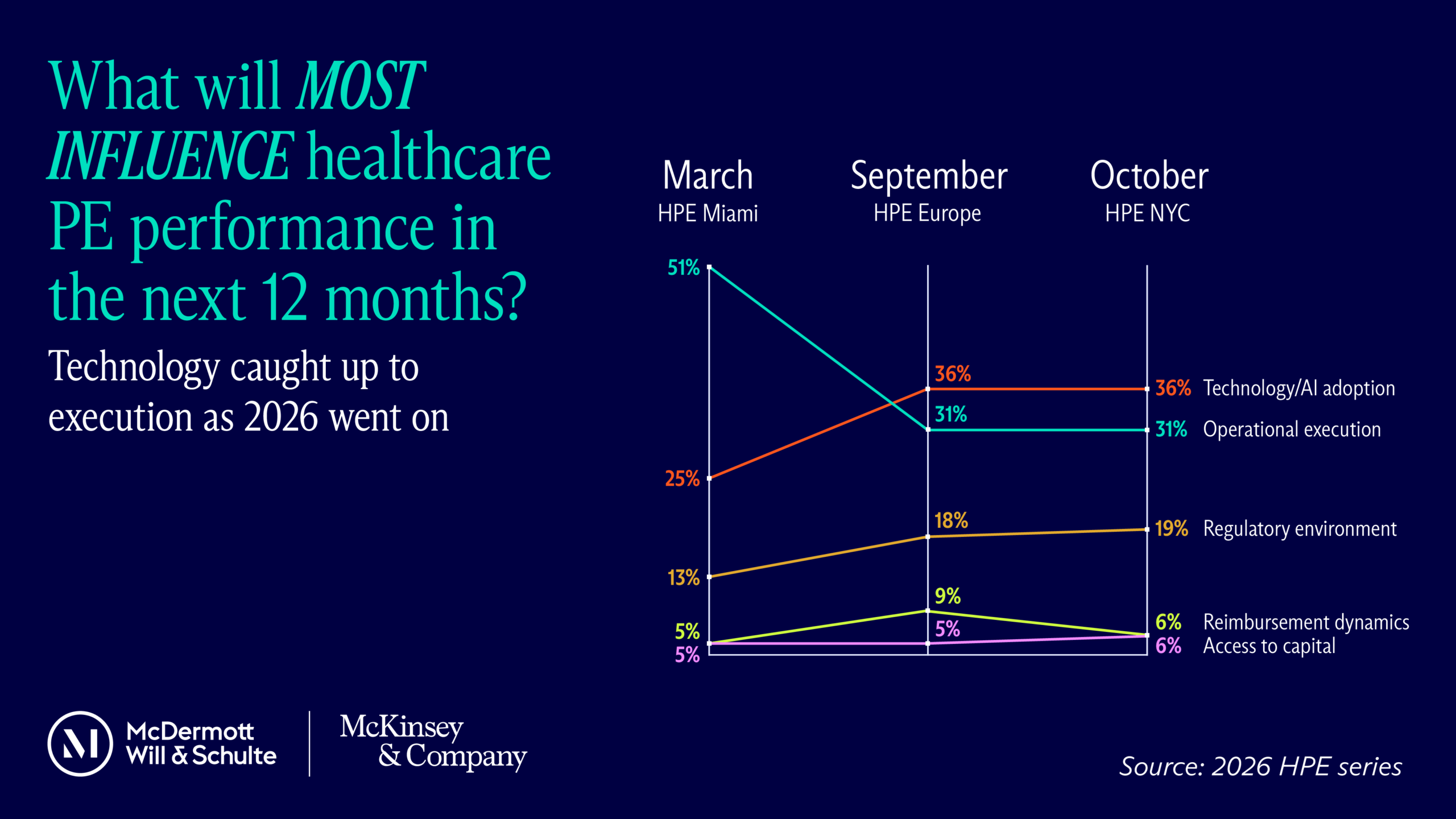
Fastest-growing profit pools are in healthcare services and tech
Healthcare sectors are seeing continued EBITDA growth, with performance varying significantly by segment. The healthcare services and technology sector represents the largest and fastest-growing sector, with investor interest concentrated in data analytics, software, and tech-enabled platforms as payors and providers seek solutions to mounting financial and operational pressures.
Panelists noted how companies demonstrating measurable return on investment (ROI) are continuing to have the biggest competitive advantage – especially as AI adoption accelerates, creating opportunities for margin expansion and growth even as competition and pricing pressures intensify.
Other areas attracting investor interest include specialty pharmacy, infusion, and other pharmaceutical services. Speakers pointed to key growth drivers in these areas, including strong specialty drug pipelines, payor pressure to move care into lower-cost settings, and growing patient preference for home- and ambulatory-based treatment.
Panelists also expressed cautious optimism as biotech funding improves and buyer-seller valuation expectations begin to converge. However, opportunities vary across subsectors, with investors focused on companies demonstrating differentiated capabilities, durable demand, operational resilience, and a deeper level of AI integration.
Panelists noted that healthcare-focused private equity (PE) firms hold approximately $400 billion in “dry powder,” giving investors more capital to deploy than in recent years.
AI’s value creation depends on level of tech integration
As discussions reiterated, the more deeply AI is embedded into a platform’s core products, services, and business model, the greater its potential to create lasting value. Panelists noted how companies are moving beyond standalone productivity tools and “table stakes” AI capabilities to integrate AI into customer-facing solutions and develop new revenue streams, which is helping to command higher valuations.
In an audience poll, attendees ranked AI-enabled solutions as the most promising investment opportunities. For investors evaluating AI-enabled healthcare businesses, the challenge is distinguishing sustainable competitive advantages from easily replicated technology.
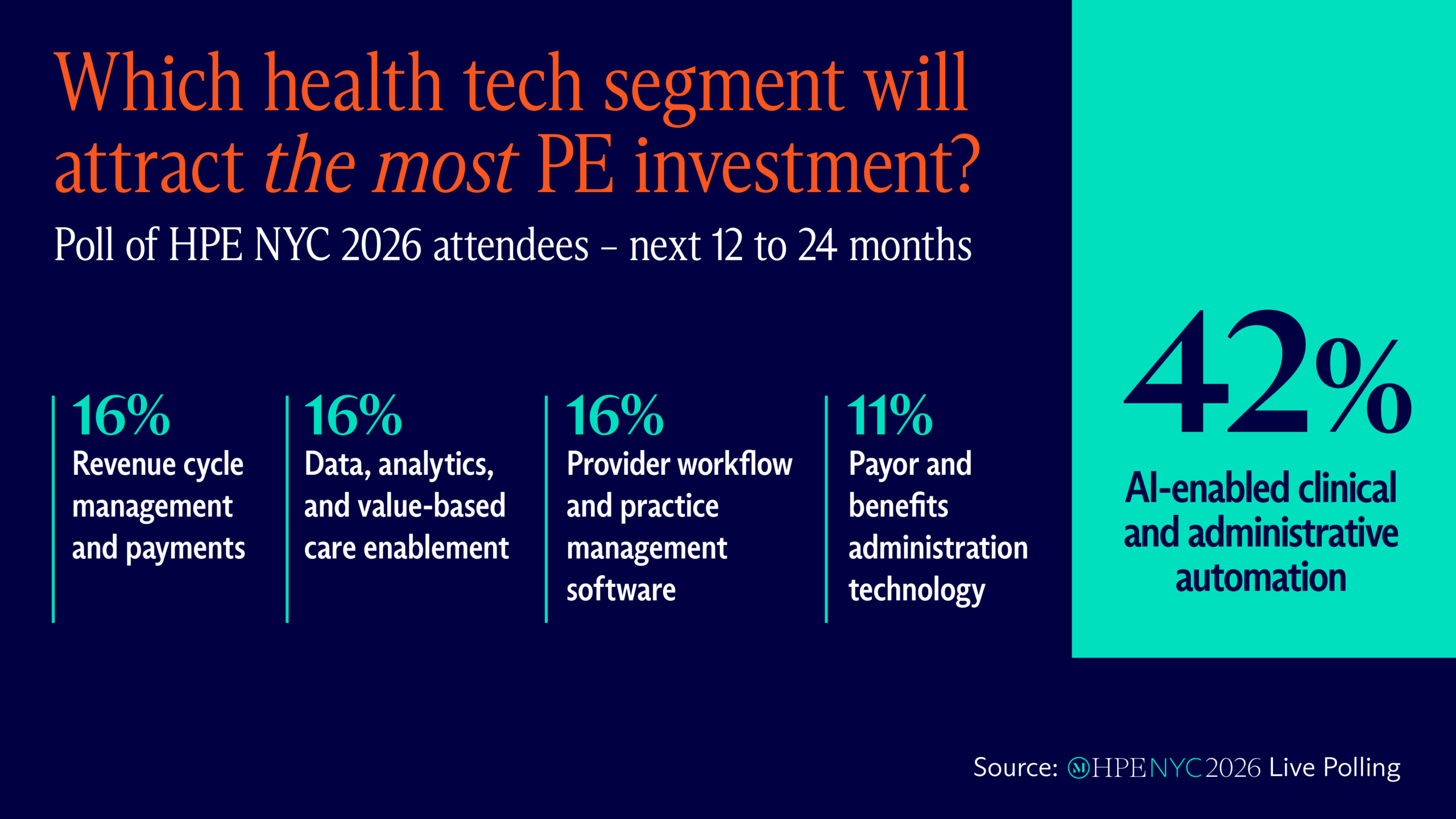
Speakers also emphasized the importance of proprietary data, deeply embedded systems, and technology that fundamentally improves workflows rather than simply adding new features. Discussions noted how companies must also demonstrate that they can successfully commercialize their solutions and drive customer adoption.
AI is similarly transforming how healthcare transactions are being evaluated and executed, and what it means to effectively manage post close. As diligence becomes more complex, investors are facing an expanding range of regulatory, operational, financial, and strategic risks. They’re also having to identify issues that could affect valuation, change deal terms, impact integration, or shift post-closing performance expectations.
But deep AI integration alone does not guarantee higher deal valuations, where speakers underscored the importance of having strong business fundamentals and the ability to translate AI investments into sustainable growth.
Creative structures are getting deals done
While there are signs of improvement, the healthcare dealmaking environment remains highly selective. Panelists described a bifurcated market in which high-quality, A+ assets in attractive sectors are driving both competition and premium valuations. This is while less differentiated companies face longer holding periods and more limited exit opportunities.
Panelists reinforced the importance of operational execution in driving returns. Participants agreed they would not pursue an investment without identifying three to five actionable operational improvement opportunities. While AI is increasingly part of that strategy, speakers emphasized that technology investments must support broader operational goals rather than serve as standalone initiatives.
Creative transaction structures are also becoming more important as sponsors prioritize liquidity and work to bridge valuation gaps. Speakers discussed growing interest in mergers of equals, carve-outs, earn-outs, and other alternative arrangements that can help facilitate transactions when traditional sale processes prove challenging.
Liquidity pressures are similarly influencing investment decisions. In an audience poll, attendees identified disagreement over valuations as the leading reason PE-backed healthcare companies are being held longer than expected. Panelists highlighted continuation vehicles and other secondary transactions as options for sponsors seeking to provide liquidity while retaining exposure to high-performing assets. These structures can also provide additional time and capital to execute growth strategies.
For businesses that lack the scale or differentiation to command premium valuations, speakers noted that operational improvements, strategic combinations, and alternative transaction structures can provide a path forward.
The bottom line
Healthcare private equity continues to offer compelling investment opportunities, but as discussions reflected, success will require greater discipline in capital deployment and value creation. Strong sector fundamentals and continued innovation support investment, while uneven performance, valuation gaps, and execution challenges prioritize a more tailored approach to dealmaking.
AI is emerging as both an investment opportunity and a tool to strengthen portfolio operations and transaction execution. For sponsors, the focus is on identifying businesses with strong competitive advantages and clear opportunities to improve financial and operational performance.