












ARTICLE
The new infrastructure premium: What the Copia Power sale signals for digital infrastructure investment
August 26, 2026
Read time: 13 min
Take a close look at the largest digital infrastructure transactions of the past decade, and a clear pattern takes shape. Investors are no longer simply buying data centers; they are buying platforms. And Carlyle’s recent sale of Copia Power to EQT (which McDermott helped lead) provides a window into the future of digital infrastructure investment.
Power is becoming part of the digital infrastructure asset itself.
In power-constrained markets, generation, interconnection, and transmission positions can determine whether – and how quickly – digital capacity can actually be delivered.
Development capability can command a premium before stabilization.
Investors increasingly may value not only operating assets, but platforms capable of repeatedly converting scarce power, land, and interconnection positions into developable digital infrastructure.
The traditional boundary between energy and digital infrastructure is disappearing.
AI-driven load growth is bringing generation, grid infrastructure, data centers, and capital formation into a single investment ecosystem.
Control of scarce inputs creates strategic optionality.
Land, interconnection rights, transmission, access, permitting positions, and power supply can provide multiple pathways to monetization as digital demand evolves.
The next major M&A opportunity may be upstream of the data center.
As capital competes for AI infrastructure exposure, some of the most strategically valuable acquisition targets may be the businesses controlling the pipeline and infrastructure required to enable future data center development.
While the $2.6 billion Copia transaction does not rank among the largest digital infrastructure transactions by enterprise value, it may prove to be one of the most strategically significant. Unlike traditional data center acquisitions, which focus primarily on operating facilities and stabilized cash flows, Copia sits at the convergence of three of the most critical infrastructure considerations in today’s market: power generation, transmission access, and AI-driven digital infrastructure demand.
With its purchase, EQT recognized that access to power has become one of the most valuable assets in digital infrastructure. At the time of the transaction, Copia had assembled a differentiated platform encompassing more than 2.6 gigawatts (GW) of generation and storage assets in operation or construction, more than nine GW of grid-connected data center development opportunities, and a broader pipeline that includes more than 25 GW of solar and storage assets and seven GW of natural gas generation.
However, the transaction’s significance extends well beyond access to power. It reflects a fundamental shift in how investors are evaluating infrastructure opportunities and where they believe future value will be created.
Looking across the 10 largest digital infrastructure transactions completed over the last decade, a distinct pattern emerges.
The first generation of digital infrastructure investment focused on acquiring scaled platform operators with established customer relationships, recurring revenues, and proven operating histories. Of those 10 largest transactions over the last decade, CyrusOne, CoreSite, Interxion, DuPont Fabros, Global Switch, and AirTrunk fit squarely within this framework. These were outstanding businesses, and investors were rewarded accordingly.
A second generation of investing is now emerging.
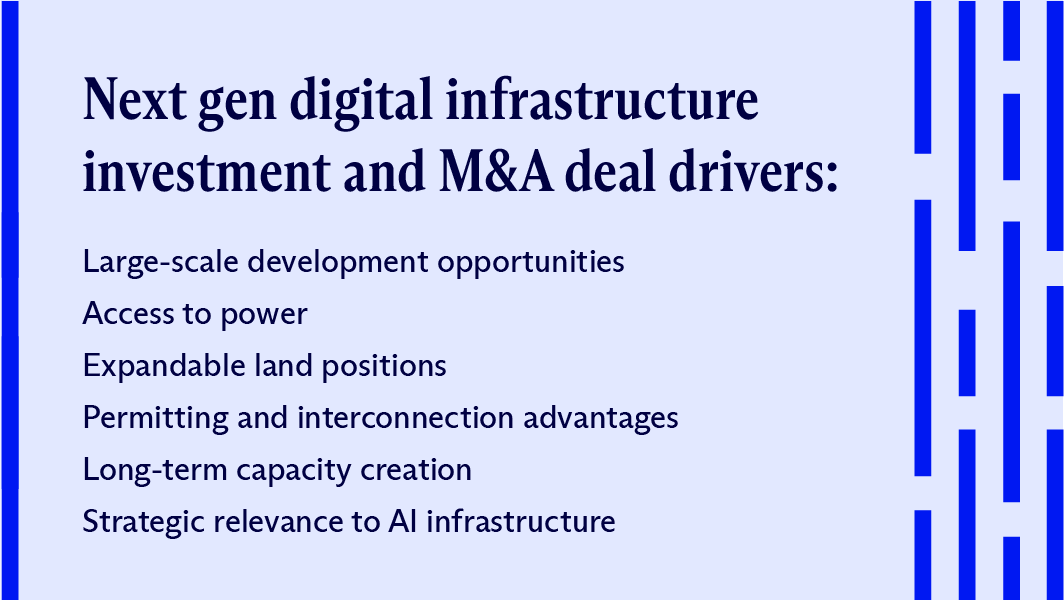
Investors are paying premiums for businesses that control the critical inputs necessary to deliver future digital infrastructure. These platforms are valued not merely for current operating performance, but for their ability to solve the industry’s most pressing constraints. In that regard, Aligned Data Centers, QTS, Compass Data Centers, and Copia Power share a similar investment thesis, because all four platforms offer some combination of the below.
The market’s largest and most sophisticated investors are increasingly underwriting future infrastructure optionality rather than simply today’s cash flow.
What made the Copia transaction particularly compelling was that it was not simply an acquisition of operating assets.
Investors were evaluating a platform that combined operational generation assets, large-scale development opportunities, transmission and interconnection positions, data center development capacity, and a management team that had demonstrated the capability to execute an integrated infrastructure strategy.
Like many of the most significant infrastructure transactions occurring today, the value proposition for investors extended far beyond Copia’s current revenues.
A substantial portion of the digital infrastructure investment thesis was tied to future development rights, infrastructure optionality, permitting status, interconnection positions, transmission access, and the platform’s ability to accelerate the deployment of both power and digital infrastructure at scale.
That investment thesis reflects a broader trend across the market. Increasingly, investors are rewarding developers that can remove multiple infrastructure bottlenecks simultaneously.
Copia also highlights how much the market has evolved from a transactional perspective.
Historically, energy transactions and digital infrastructure transactions involved separate investors, separate advisors, and separate legal disciplines. That distinction is evaporating.
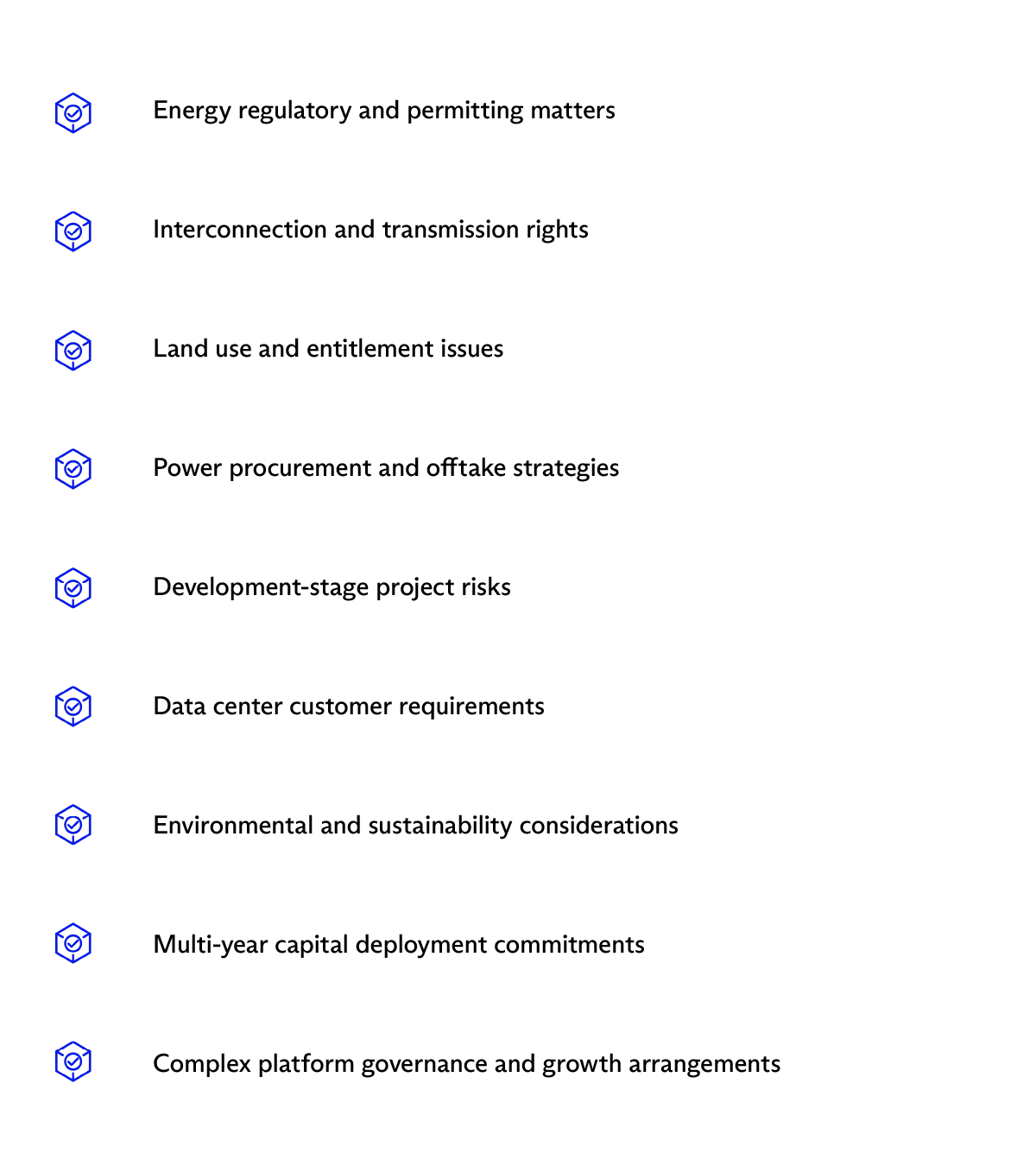
Transactions at the intersection of energy and digital infrastructure require investors to evaluate a broader set of considerations than many traditional infrastructure acquisitions, including:
The result is that infrastructure investors are increasingly seeking advisors and management teams that understand both energy infrastructure and digital infrastructure, because future value creation depends on integrating the two.
Although the largest transactions differ in size, geography, structure, and timing, they share several common characteristics.
Scale wins.
Every one of the largest transactions involved a platform capable of supporting hyperscale deployment and multi-year growth.
Platforms outperform projects.
Investors consistently assign premium valuations to businesses with repeatable development capabilities rather than individual assets.
Development optionality commands premiums.
Buyers are increasingly willing to pay for future capacity creation, not merely existing operations.
Infrastructure capital has become the dominant buyer.
Major global alternative asset managers, alongside Brookfield, EQT, KKR, GIP, CPPIB, IFM, and leading sovereign wealth and pension funds appear repeatedly across these transactions.
AI is accelerating everything.
Artificial intelligence is dramatically increasing demand for both digital infrastructure and the power necessary to support it.
The industry is moving beyond a world in which data centers, power generation, transmission infrastructure, and energy development are viewed as separate sectors. The next generation of infrastructure platforms will combine all of these capabilities, and investors are already responding accordingly.
The largest transactions are no longer being driven exclusively by existing operating assets. Instead, they are increasingly being driven by access to power, development pipelines, transmission capacity, interconnection positions, land, and the ability to deliver infrastructure at scale.
Copia is emblematic of that shift.
The future of digital infrastructure is about the ecosystem necessary to power it, rather than just computing. And the last decade of M&A activity demonstrates that the developers, investors, and infrastructure platforms capable of bringing power and digital infrastructure together will continue to command the strongest market interest and the highest valuations.