













ARTICLE
7 life sciences investment trends to watch in 2027
Read time: 14 min
Life sciences investing will enter 2027 on firmer footing than a few years ago, despite regulatory uncertainty and evolving drug development challenges. Pharma mergers and acquisitions (M&A) remain strong in 2026, following 2025’s robust activity; biotech financing is emerging from a multiyear winter; and artificial intelligence (AI) is changing what drug discovery looks like. Pricing pressure and geopolitical risk are shaping how investors evaluate these opportunities, while the US midterm election results add another layer of uncertainty.
At our recent Life Sciences Investment Forum, speakers examined how these trends are shaping pharma and biotech investment and identified seven themes influencing the market’s trajectory.
1. Strategic M&A leads the liquidity outlook
In an audience poll, 83% of respondents identified strategic M&A as the expected primary source of liquidity over the next 12 to 24 months. Speakers credited M&A as the main value generator over the past five years, particularly as public markets remained challenging. They also highlighted how M&A activity supports the broader financing market by returning capital to investors, who can then redeploy those proceeds into new investment opportunities, including initial public offerings (IPOs).

For companies with a credible IPO path, speakers favored preparing for a public listing while also pursuing a strategic sale. Running these tracks in parallel allows boards to keep both options open as market conditions evolve and weigh a concrete acquisition offer against the IPO valuation and dilution, and follow-on capital needs post-IPO.
2. The biotech funding recovery is bifurcated
Panel discussions revealed that biotech financing is recovering unevenly. Later-stage companies with compelling clinical data are raising capital more readily, while early-stage company formation remains below its late-2010s pace. Established venture funds are also continuing to raise money and form new companies, even as investors digest what public-market developments may mean for related private programs.
Mixed clinical results and shifting investor experience are complicating financing decisions, according to speakers. Recent clinical readouts have caught some investors off guard, prompting greater scrutiny of companies pursuing similar therapeutic pathways. This heightened selectivity is also affecting IPO activity, as investors reassess risk and become more cautious about backing companies with uncertain clinical prospects.
Speakers also pointed to opportunities in medtech, where historically low valuations are offering attractive entry points for buyers with the appetite and expertise to make operational improvements.
3. Deal structures are broadening as capital becomes more selective
Forum discussions highlighted how companies and investors are increasingly tailoring transactions to the risks they are willing to assume. In M&A, earnouts and contingent value rights can bridge valuation gaps by tying part of the price to development or commercial milestones. A license can offer comparable economics when a credible partner is positioned to deliver downstream payments, and the company can retain rights to other programs.
Speakers also noted the growing pool of royalty investors in the market, giving life sciences companies more options to fund drug development or finance a launch. Selling an existing royalty stream or a share of future net sales can limit equity dilution but requires companies to give up a portion of the asset’s future proceeds.
When assessing a carve-out, speakers asserted that buyers should factor the cost of separation and the need for ongoing seller support into what they are willing to pay. A spinout can give an individual program access to dedicated funding while allowing the originating company to focus its resources on advancing earlier-stage assets to proof of concept.
4. R&D spending is shifting toward defined programs and partnerships
Rising development costs are prompting companies to concentrate research and development (R&D) spending on specific programs, marking a shift from the broader platform investments favored during the biotech boom. For early-stage platform companies, this places greater emphasis on the lead program. Speakers noted that a clear path to proof of concept helps investors assess the platform’s potential and the capital required. An academic collaboration or licensing arrangement can help generate the data needed to raise an institutional round, while a target-specific partnership can provide upfront, nondilutive capital and preserve the potential for milestone payments and royalties.
Speakers noted how pharma companies face a related capital deployment choice, with the timing of expected returns shaping the type of deal they pursue. In-licensing an earlier-stage program can replenish the pipeline over time, while acquiring a near-market asset can help bridge a revenue gap and support growth over the next three to four years.
5. AI partnerships are putting a premium on data and development expertise
As AI models become more widely available, forum speakers pointed to high-quality proprietary data and drug development expertise as key investment differentiators. They also urged pharma companies to consider whether a prospective AI partner’s business model and exit plans align with the program’s development timeline and ensure collaboration agreements detail how each party can use project data, including how they will document human contributions to inventions.
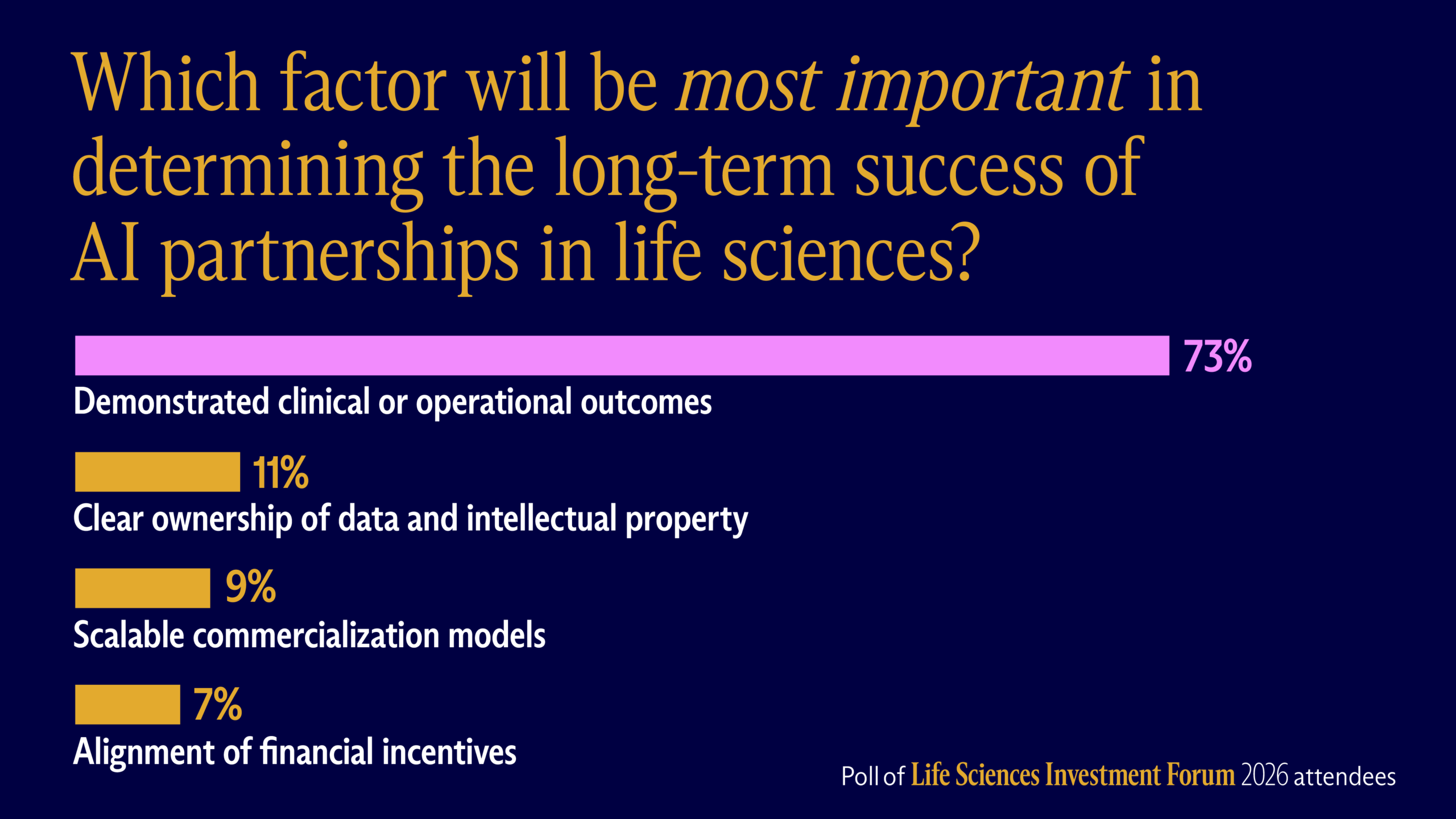
Audience polling reinforced the importance of tangible results, with 73% of respondents identifying demonstrated clinical or operational outcomes as the most important factor in determining the long-term success of AI partnerships in life sciences.
Speakers highlighted joint principles from the US Food and Drug Administration (FDA) and European Medicines Agency for evaluating AI models used to generate regulatory evidence. They also pointed to the European Union’s AI Act and General Data Protection Regulation as considerations for model deployment and use of personal data.
6. Chinese biotech is reshaping the economics of pipeline sourcing
Global pharma is increasingly looking to China to replenish its drug pipelines, with forum speakers flagging that Chinese biotech firms have narrowed the gap with global peers in terms of clinical data quality, intellectual property, and regulatory pathways. Speakers cited two transactions in which Chinese clinical data supported direct entry into US registrational studies, potentially shortening development timelines.
In-licensing from China can still cost less than sourcing comparable US or European assets, even as the pricing gap narrows. Speakers noted how developers with differentiated programs are gaining bargaining power, while buyers retain leverage in crowded targets. For licensees, a deal’s value depends on how much development the existing evidence can support and what additional studies will cost.
7. Policy uncertainty is moving into deal underwriting
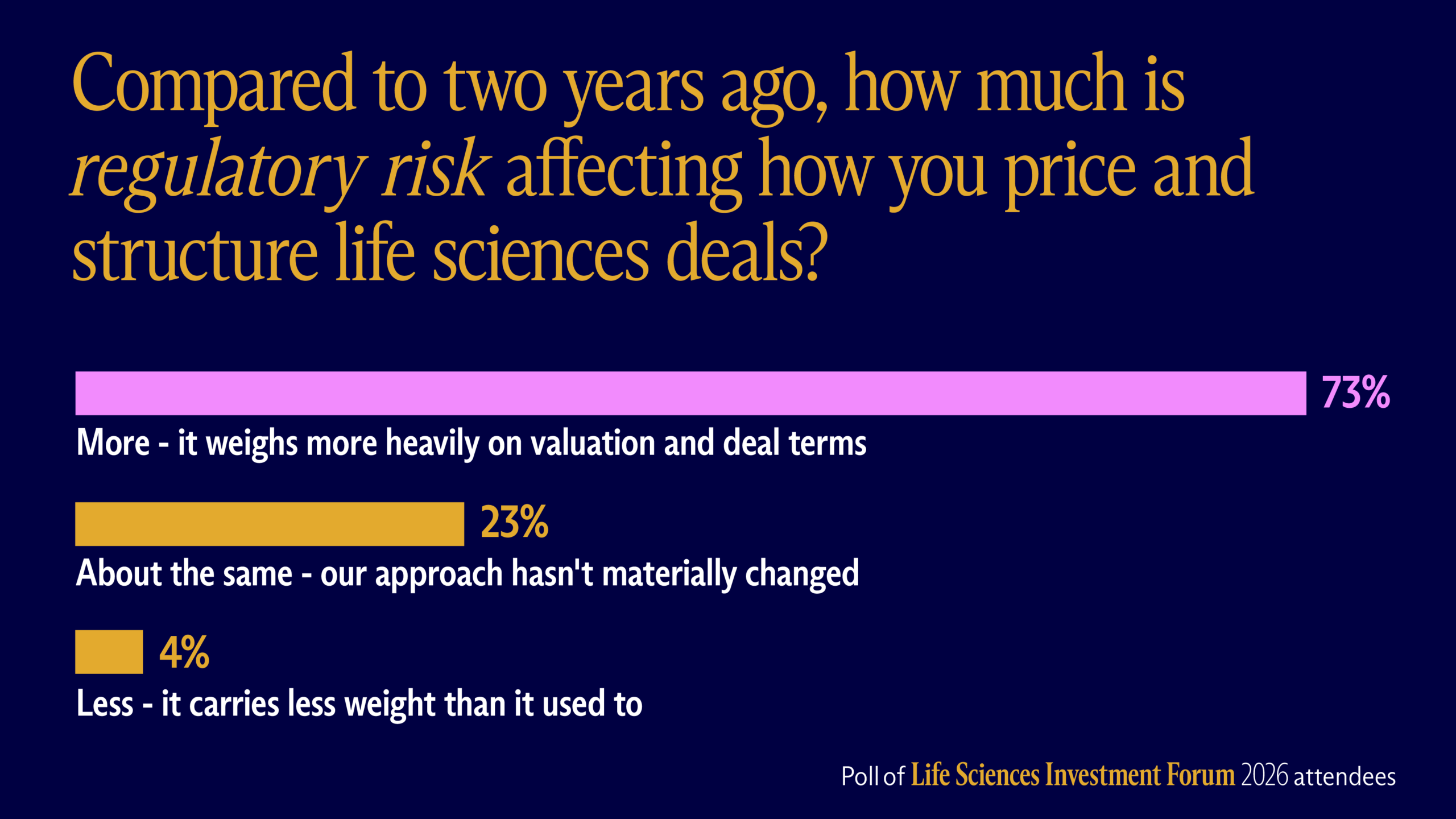
Regulatory risk is playing an increasingly significant role in how life sciences deals are evaluated and structured, as the recent US midterm elections add another layer of uncertainty to the policy outlook. In an audience poll, 73% of respondents said regulatory risk weighs more heavily on valuations and deal terms than it did two years ago, underscoring the growing importance of policy considerations in investment decisions.
Despite this uncertainty, speakers identified drug affordability and US competitiveness with China as bipartisan priorities for the sector. With higher rebates already pressuring net revenue, speakers emphasized to buyers the importance of determining how Medicare drug price negotiations under the Inflation Reduction Act of 2022 and most-favored-nation pricing initiatives could affect expected cash flows and upfront valuations.
Panelists also discussed leadership transitions at the FDA. Where a launch forecast assumes accelerated review under the FDA’s Commissioner’s National Priority Voucher pilot program, investors should test whether the company has enough cash to reach launch on a standard review timeline.
Discussions also focused on the impact of tariffs on imported components, which can squeeze margins for medtech suppliers even when final assembly takes place in the United States. Qualifying an alternative supplier takes time, where buyers should assess how long higher costs could weigh on margins and whether the company can pass them through to customers.
Looking ahead: Positioning for the next cycle
Forum speakers pointed to a life sciences market with a myriad of ways to fund and advance promising assets, but investors are placing greater emphasis on evidence support. For operators planning the next stage of development, that means identifying the clinical or regulatory milestone most likely to attract a buyer or partner, then working backward to determine how much capital it will take to get there. That funding need gives companies a basis for weighing equity dilution against the future economics they might give up in a licensing or royalty deal.
For investors, the same milestone can anchor the decision about how much to commit upfront. A longer development timeline can increase funding needs, while lower net pricing can reduce the asset’s value even if it reaches the market on schedule. Tying further investment to specific milestones can give operators the capital to advance a program and investors a clear basis for deciding when to fund the next stage.
Continue the conversation at the 2027 J.P. Morgan Healthcare Conference in San Francisco. Join us at our annual SPIN reception on January 12 and meet with the McDermott Will & Schulte team January 11–12 in our private space at The Ritz-Carlton.

