













ARTICLE
EU and UK remain selective in merger case outcomes: A breakdown of Q2 2026 M&A news
August 20, 2026
Read time: 6 min
In Q2 2026, EU and UK authorities continued to sharpen how they assess dynamic markets, efficiencies and jurisdiction, while remaining selective in case outcomes. The European Commission’s draft Merger Guidelines and the Competition and Markets Authority’s (CMA’s) efficiencies consultation give parties clearer hooks to argue for clearance based on innovation, investment, and rivalry-enhancing benefits. At the same time, the threat of a transaction being called in when below the threshold (via Article 22) is a less-dependable route for third parties seeking EU review. The practical message is straightforward: Parties should consider competitive dynamics early, building a record with transaction-specific evidence on closeness of competition, customer switching, entry, global constraints, and merger-specific efficiencies.
Efficiencies and dynamic competition move up the agenda
- The Commission’s draft Merger Guidelines signal a more updated framework for dynamic competition, innovation, investment, resilience, sustainability, and global competitiveness.
- In the UK, the CMA’s consultation on rivalry-enhancing efficiencies sits alongside its 4Ps agenda of pace, predictability, proportionality and process.
- The key change is practical rather than doctrinal: Authorities appear increasingly willing to engage with efficiency claims, but only where they are merger-specific, verifiable, and supported by contemporaneous business evidence. Deal teams should therefore build an efficiencies narrative early in the transaction process rather than treating it as a late-stage advocacy tool.
Article 22 is a narrower route for below-threshold complaints
- After Illumina/Grail and the withdrawal of the 2021 Article 22 guidance, the Commission cannot accept referrals from Member States with national merger control regimes where those authorities lack jurisdiction under national law.
- Q2 showed the practical effect: Complainants may still seek to generate referral risk, but the route to Brussels now depends on an available national hook.
- Referral risk remains relevant, particularly in concentrated or innovation-driven markets, but below-threshold deals now face a more predictable jurisdictional landscape and a narrower path to Commission review.
Outcomes remain segment-specific and evidence-led
- Recent EU, UK, and German cases point to pragmatism rather than a uniform tightening or loosening of merger control.
- Authorities cleared complex transactions where evidence showed limited closeness of competition, differentiated strategies, complementary capabilities, or strong global constraints.
- Where concerns were narrower, remedies were targeted to the actual theory of harm; parties should therefore define overlaps carefully and prepare evidence on switching, entry, customer alternatives, and remedy scope.
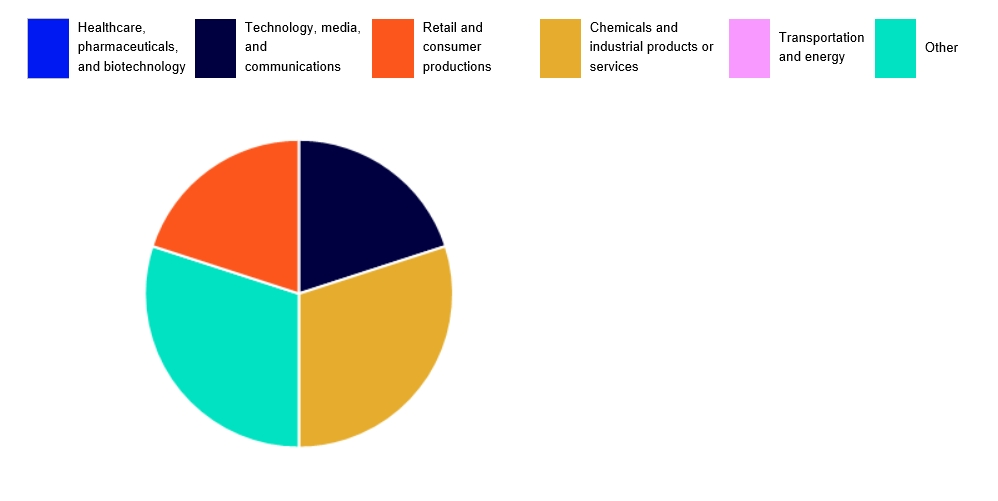
Number of enforcement actions in key industries1
Snapshot of selected enforcement actions2
Time from signing to clearance
Time from signing to clearance
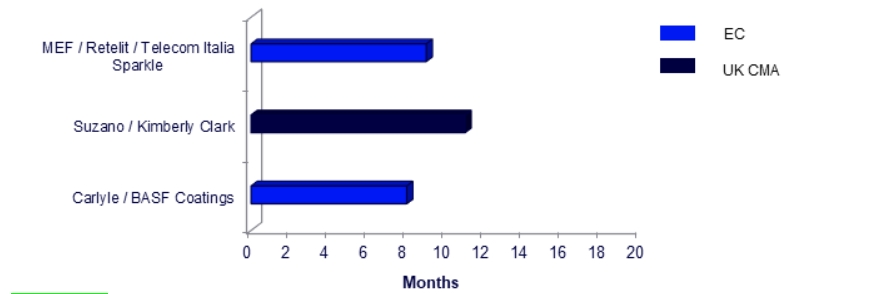









1. For Europe and the United Kingdom, the graphs include cases where an antitrust enforcement agency issued a Phase 2 process or a clearance decision, or challenged the transactions, or the transaction was abandoned after an antitrust investigation.
2. These graphs are based on McDermott internal analysis and public press reports and filings. These graphs do not represent a complete list of all matters within a jurisdiction.