













ARTICLE
Healthcare private equity outlook: Takeaways from HPE Miami 2026
March 30, 2026
Read time: 6 min
At McDermott Will & Schulte’s HPE Miami 2026 conference, more than 2,000 healthcare founders, investors, advisors, and leaders came together to discuss the structural and policy forces reshaping the health and life sciences investment landscape.
As HPE Miami’s official knowledge partner, McKinsey & Company joined the conversations and, together with McDermott, we outline the key trends buyers and sellers discussed as they position transactions for 2026 and beyond.

Performance and investment considerations
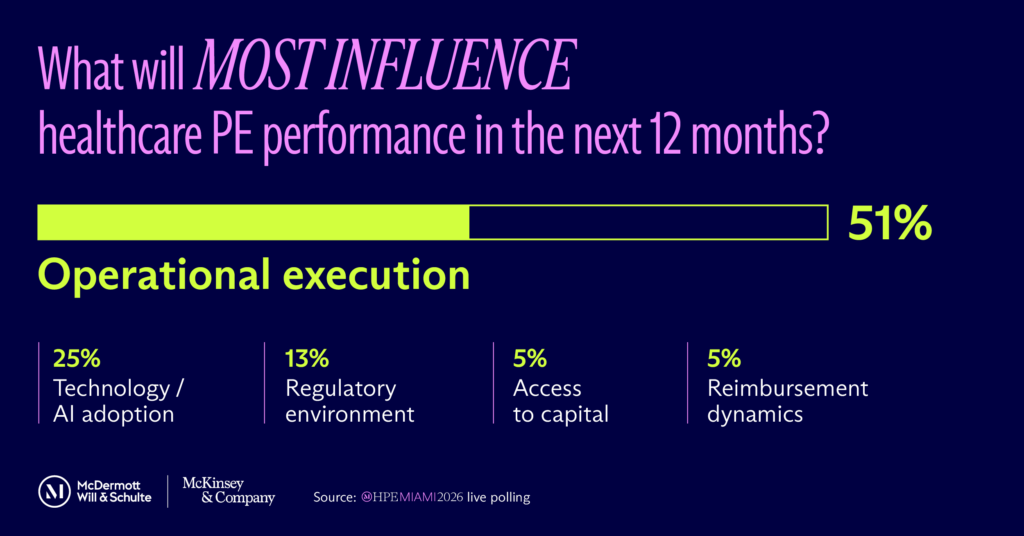
1. Operational execution, not financial engineering, is expected to be a primary driver of PE performance over the next 12 months
In a live poll during an HPE Miami panel, participants ranked “operational execution” as the most significant determinant of near-term investment performance.
According to the sentiment among attendees, gone is the traditional model of acquiring strong healthcare businesses and relying primarily on strategic guidance from the boardroom. Instead, PE firms are expected to have deep operational capabilities and specialized expertise within portfolio companies to move beyond high-level strategy and actively support operational improvements.
2. Compliance and quality will continue driving value creation
Panelists spoke to how compliance, quality management, and overall operational rigor are increasingly central to private equity value creation strategies. In healthcare, regulatory oversight can materially affect enterprise value and transaction outcomes. Quality failures, billing compliance issues, or regulatory enforcement actions can impact growth strategies or exit timelines.
3. Talent and leadership will be a key investment criterion
Attendees also heard that, because many healthcare service platforms operate across multi-site networks, effective execution requires leadership capabilities that extend beyond the executive team. For private equity investors, talent diligence at target organizations is becoming as important as financial diligence. Evaluating leadership depth, succession planning, and management scalability can significantly influence investment decisions and outcomes.
4. Strategic discipline will be important when evaluating healthcare platforms
Panelists noted that top-performing healthcare platforms frequently succeed by focusing on a limited number of high-impact operational priorities rather than attempting to pursue too many initiatives simultaneously.
5. Creative deal structures can address valuation gaps
Differences in buyers’ and sellers’ valuation expectations can delay transactions or even stall the sale process, as several panelists cautioned. To help, investors are looking to more creative deal structures for smoother transactions, including corporate carve-outs, management partnerships, smaller initial acquisitions for platform builds, and tying transaction structure to future growth milestones.
Rebounds and regulatory readiness
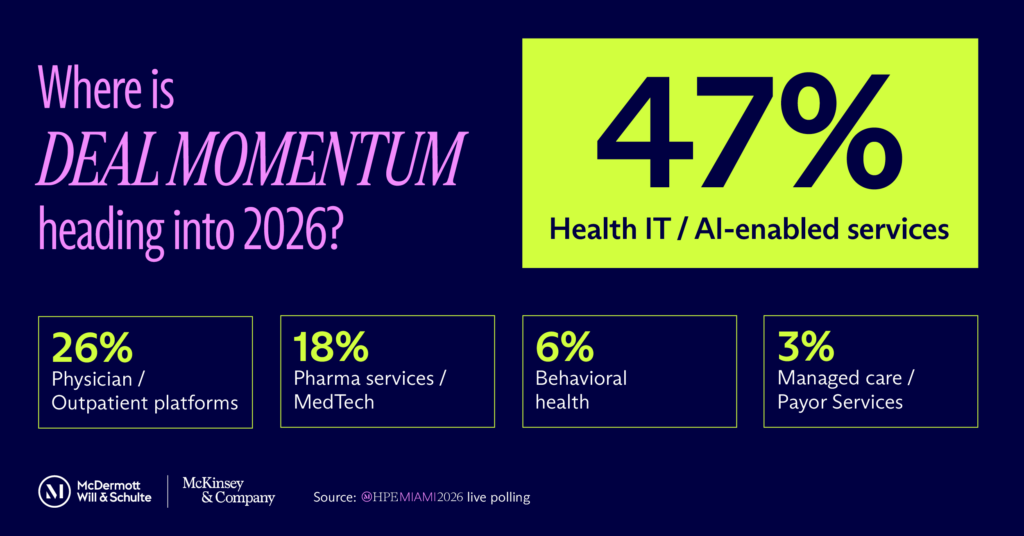
1. Tech and AI-enabled services are driving deal momentum
In terms of deal momentum, 47% of HPE Miami poll respondents cited health IT/AI-enabled services as the main driver, reflecting growing investor interest in platforms to help healthcare organizations navigate mounting cost and regulatory complexity. Buyers may consider prioritizing targets with scalable technology infrastructure and clear pathways for integrating AI into core healthcare workflows.
2. Replenished pharma pipelines are driving M&A recovery
Pharmaceutical companies largely continue to drive recovery in life sciences M&A activity as they seek to replenish drug pipelines, panelists told attendees – a priority, given patent expirations are projected to eliminate nearly $300 billion in revenue by 2028 (McKinsey). Because the majority of new molecular entity revenues since 2018 have originated from externally sourced innovations (McKinsey), the industry has seen an increasing reliance on strategic partnerships, acquisitions, and licensing agreements as growth drivers.
3. Drug development is going global, and life cycles are being compressed
Panelists also reflected that a recent flurry of activity emerging from Asia, particularly in China and South Korea, has led to significant drug innovations. Companies pursuing cross-border licensing and development partnerships must have the right support in place to navigate regulatory frameworks involving intellectual property (IP) protections, export controls, data governance rules, and international clinical trials approvals.
They further noted that faster biosimilar entry, pricing reforms, and regulatory changes are shortening the window during which new therapies come to market and generate peak revenue. These shifts have forced pharmaceutical companies to accelerate development timelines and engage CROs, CDMOs, and regulatory advisors even earlier in the drug development process.
McDermott’s key ideas and actions for healthcare investors and platform operators
McDermott expanded on these discussions to identify sharp insights and suggestions from the conversations at HPE Miami.
- Consider creating a value creation playbook that incorporates compliance and regulatory oversight as core operational priorities, including structured initiatives around:
- Clinical quality monitoring
- Billing and coding compliance
- Regulatory risk management
- Data governance and privacy compliance
- Operational process improvements supported by automation and AI
Evaluate these focus areas throughout the diligence phase of transactions, rather than solely after closing. In that way, investors are underwriting value creation based on these areas’ ability to improve operational discipline and compliance infrastructure within portfolio companies.
- Deep operational experience is a core differentiator of the shrewdest buyers and investors. Firms with the right level of expertise – those capable of making significant operational improvements in strategic, discrete focus areas – have the greatest potential to drive efficiencies that generate outsized returns.
- Regulatory compliance and quality management must be central components of any value creation strategy. Investors must increasingly evaluate these capabilities during diligence and incorporate them into post-acquisition operational plans.
- Strong leadership development processes and talent pipelines are critical for successfully scaling healthcare platforms, particularly in multi-site businesses where operational efficiencies and consistency directly affect performance. High-performing healthcare organizations should consider investing in leadership development pipelines several layers below the C-suite to ensure operational consistency across regional markets and service lines.
- Creative transaction structures and early exit preparation are becoming essential in navigating today’s healthcare deal environment, where valuation expectations, regulatory complexity, and diligence scrutiny continue to shape transaction outcomes.
As always, we look forward to continuing the dialogue with our clients and partners. Please reach out to explore any of these themes further.
A version of this recap was also published to the McKinsey Healthcare Blog.