












ARTICLE
Legal Lens on the Unified Patent Court | Q2 2025
June 2025
Read time: 17 min
The Unified Patent Court (UPC) is revolutionizing the way patents are enforced in Europe, and McDermott’s intellectual property (IP) team is here to help you navigate this dynamic landscape. Our Legal Lens on the Unified Patent Court newsletter aims to keep patent holders and legal departments well-informed. McDermott’s on-the-ground team in Germany, France, the United Kingdom, and the United States offers a unique cross-border perspective on the issues to help put them in a global context.
Preliminary injunctions before the UPC are intended to provide swift and effective legal protection. But how high is the threshold for issuance? Two recent decisions by the UPC Court of Appeal (CoA) – Biolitec v. Lightguide (UPC_CoA_540/2024) of February 24, 2025, and Insulet v. EOFlow (UPC_CoA_768/2024) of April 30, 2025 – provide further guidance on preliminary injunctions before the UPC.
The cases at a glance
In Biolitec v. Lightguide, Biolitec applied for a preliminary injunction against Lightguide group companies to stop the distribution of a medical single-use product. Because the product had been on the market for several years (well before the patent was granted in July 2024), the Court of First Instance (the Local Division Düsseldorf) rejected the application because of a lack of urgency. The CoA affirmed this decision on appeal.
The key point of the CoA’s decision is the interpretation of the “necessity” requirement for interim measures under Rule 211 of the UPC Rules of Procedure (RoP) and Article 62 of the Agreement on a Unified Patent Court (UPCA). The CoA clarified that credible patent infringement alone is not sufficient. Applicants must show why awaiting the main proceedings would be unreasonable and why only immediate judicial action can provide effective legal protection. This may be the case, for example, where a new product threatens to disrupt the status quo of the market or where irreparable harm is imminent following the grant of the patent, such as offering the infringing product at medical trade fairs, loss of tender opportunities, or irreversible price erosion. Because Biolitec failed to substantiate any such risk, it could not show why waiting for the main proceedings would be unreasonable. Thus, the CoA affirmed the rejection of the preliminary injunction.
In Insulet v. EOFlow, Insulet applied for a preliminary injunction to stop distribution of EOFlow’s insulin patch pump system. The Court of First Instance (the Central Division Milan) rejected the request, mainly because of doubts about novelty. On appeal, the CoA reversed, finding infringement and granting interim relief. The CoA clarified that claim interpretation is a matter of law, corrected the Central Division Milan’s flawed interpretation of key claim features, and found the patent claims likely novel. In addition to affirming the principles from Biolitec v. Lightguide, the CoA set requirements regarding risk of repeated infringement and commented on the balancing of customer interests.
Trends at the UPC: Tightening standards in UPC appeals
These recent decisions confirm that the CoA does not follow a uniformly strict or lenient approach to preliminary injunctions but rather assesses each case individually. Applicants must substantiate both the infringement and the necessity of the requested measure – the context, arguments related to market position, competitive dynamics, and even customer interests may be decisive factors.
A look at past CoA decisions on preliminary injunctions shows a balanced picture:
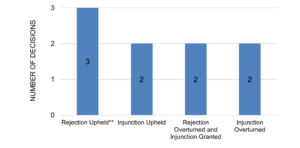
*Includes decisions from the start of the UPC to April 2025.
**Two of the three decisions concern parallel cases.
In most cases, the pivotal points in granting preliminary measures were the likelihood of infringement and the validity of the patent in question. That is, on the specifics of the case rather than on particular standards of urgency. Thus, it appears there is no discernible conclusion that the CoA is applying the standards for preliminary injunctions more strictly than the courts of first instance.
Emerging principles
From the CoA’s recent rulings, the following principles for preliminary injunctions under the UPCA have emerged:
- Summary assessments must result in the UPC finding it more likely than not that the applicant is entitled to initiate the proceedings, that the patent is (or is likely to be) infringed, and more likely than not that the patent is valid. The burden of proof for entitlement, infringement, and all other facts supporting the application lies with the applicant. Conversely, unless the case is decided ex parte (e.g., without hearing the defendant), the burden of proof for invalidity and any facts supporting the defendant’s position rests with the defendant (NanoString v. 10xGenomics, UPC_CoA_335/2023, App_576355/2023).
- Necessity is a material requirement. Clear infringement and a high probability of patent validity alone are not sufficient. Applicants must demonstrate why only interim relief ensures effective protection (Rule 206.2(c) of the RoP; Biolitec v. Lightguide). It may be best to wait for the main proceedings if the conduct in question has persisted for some time (Biolitec v. Lightguide).
- Irreparable harm is not a mandatory condition but can strongly support necessity (Ortovox v. Mammut, UPC_CoA_182/2024). This is particularly true in cases of direct competition and risk of market displacement (Insulet v. EOFlow). Claims of harm must be specific and well-supported in court of first instance proceedings. General assertions of market loss or price erosion are insufficient. New arguments on appeal may be rejected as late-filed (Biolitec v. Lightguide).
- Customer interests can be considered in the overall balancing but do not prevent relief if the product is not indispensable or alternatives exist (Insulet v. EOFlow).
- A cease-and-desist declaration with a contractual penalty is typically required to negate the risk of repeated infringement (Insulet v. EOFlow).
The CoA emphasizes the case-specific and exceptional nature of provisional measures, the protection of the status quo, and the careful balancing of the parties’ conflicting interests.
Comparative perspective: The approach under German case law
As the UPC’s principles regarding the standards for preliminary injunctions emerge, they appear to largely align with established standards in German practice. Given the conceptual overlap, a closer look at the German approach can offer valuable guidance to the still-evolving UPC case law and help gauge the prospects and risks of interim relief before the UPC.
As with the UPC, a key requirement in German case law is the likelihood of infringement. If the facts are clear and the validity of the patent is not contested, the chances of success are good. Conversely, significant doubts about validity or complex factual or legal questions often lead to rejection.
Particularly, German courts consider several important factors, including:
- Whether the patent has survived a prior opposition or nullity challenge
- Recognition of patent validity by competitors or licensees
- Prior infringement rulings on the same patent or similar products.
Ongoing opposition proceedings, newly discovered prior art, or minimal inventive step can raise doubts about a patent’s validity, which reduces the likelihood of a preliminary injunction being granted.
Necessity is also an independent requirement in German law. Interim relief is only granted when main proceedings cannot be reasonably awaited. For example, if:
- The patent will soon expire.
- Irreversible market displacement or price erosion is likely (e.g., in the case of medicinal products and generic market entry).
- The infringement is short-lived or tied to imminent events (e.g., trade fairs).
- Enforcement of the patentee’s rights would otherwise be thwarted.
Takeaways
The CoA’s current case law on preliminary injunctions makes clear that each case is decided on its individual merits. The key criterion remains whether it is unreasonable for the applicant to wait for the main proceedings. Only when this criterion is substantiated and proven will the UPC grant interim relief. The overarching goal is to avoid disproportionate harm on either side. This makes the threshold for preliminary measures high but not insurmountable. A well-prepared, prompt application backed by solid evidence and supported by insights from national practice can significantly improve the chances of success.